
Evaluating Remote Surveillance Solutions for Denver’s Growing Businesses

When evaluating remote surveillance solutions, businesses should assess their specific vulnerabilities and security challenges first. Consider factors like 24/7 monitoring capabilities, cost-effectiveness compared to traditional guard services, scalability for future growth, and compatibility with your facility type. The right system should address your unique security needs while fitting within your budget constraints.
Denver’s business landscape expanded by 12% in 2023, with new construction projects in RiNo, cannabis facilities in Green Valley Ranch, and tech startups filling LoDo office spaces. This growth brings security challenges that traditional guard services can’t always address cost-effectively. Remote surveillance solutions offer Denver businesses 24/7 monitoring at a fraction of the cost, but choosing the right system requires understanding your specific vulnerabilities.
Most business owners approach surveillance backward. They start with cameras, then wonder why their system fails during critical incidents.
Why Remote Surveillance Solutions Work Better in Denver’s Climate
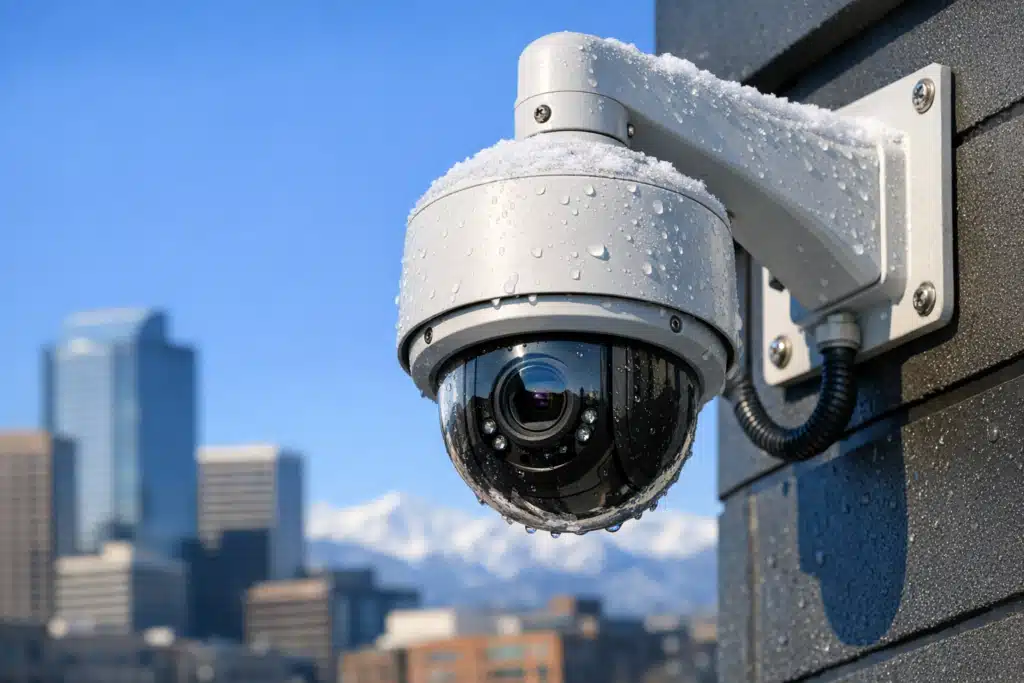
Denver’s 5,280-foot elevation creates unique surveillance challenges. Temperature swings from -10°F winter nights to 100°F summer days stress camera components differently than sea-level installations.
High-altitude considerations for camera placement:
- UV exposure degrades plastic housings 30% faster than coastal locations
- Rapid temperature changes cause lens condensation in standard enclosures
- Snow accumulation blocks views for 60+ days annually without proper heating
- Chinook winds create dust storms that require sealed IP67-rated housings
Twin City Security Denver installs weather-resistant systems designed for Colorado’s Front Range conditions. Our cameras maintain clarity through spring snowstorms and summer hail.
Seasonal Monitoring Adjustments
Denver businesses need different surveillance coverage throughout the year. Construction sites face theft spikes during winter shutdowns. Cannabis facilities deal with increased break-in attempts during harvest season.
Effective remote monitoring adapts to these patterns. Motion detection zones expand during low-activity periods. Alert thresholds adjust for seasonal lighting changes.
Cost Analysis: Remote Surveillance vs. Traditional Guards
Denver security guard wages average -22 per hour. A single guard position costs $37,000-46,000 annually with benefits.
Remote surveillance delivers comparable coverage for significantly less:
- Basic 4-camera system with monitoring: $300-500 monthly
- Advanced 16-camera network with AI detection: $800-1,200 monthly
- Enterprise solution for large facilities: $1,500-2,500 monthly
The math becomes compelling quickly. One guard costs more than comprehensive remote monitoring for most mid-size Denver businesses.
Hidden Costs to Consider
Remote surveillance systems require ongoing investment beyond initial installation. Internet bandwidth, cloud storage, and monitoring service fees add up.
Budget for these recurring expenses:
- High-speed internet upgrade: $100-300 monthly
- Cloud video storage: $50-200 monthly per camera
- Professional monitoring service: $150-400 monthly
- System maintenance and updates: $100-250 monthly
Even with these additions, total costs remain below traditional guard services while providing broader coverage.
Technology Features That Matter for Denver Business Security
Not all surveillance technology works equally well in Denver’s environment. Focus on features that address local challenges.
Essential capabilities for Colorado installations:
- Low-light performance for early winter darkness
- Thermal imaging for perimeter detection
- AI-powered analytics to reduce false alarms from wildlife
- Mobile alerts that work during mountain area dead zones
- Local storage backup for internet outages
AI Analytics Reduce False Alarms
Denver businesses deal with unique false alarm triggers. Prairie dogs activate motion sensors. Urban deer wander through parking lots. Wind moves loose construction materials.
Modern AI analytics distinguish between genuine security threats and environmental factors. The technology learns normal patterns for your location, reducing nuisance alerts by 80-90%.
This intelligence proves critical for cannabis facilities, where false alarms trigger expensive security company responses and potential regulatory issues.
Integration with Denver Emergency Services
Effective surveillance systems connect seamlessly with local emergency response. Denver Police Department responds faster to verified security alerts than general alarm calls.
Professional monitoring services can provide this verification. Trained operators review live footage and confirm threats before contacting authorities. This verification often moves your call higher in the dispatch priority queue.
Regulatory Compliance for Cannabis Operations
Colorado cannabis facilities face strict surveillance requirements under state regulations. The Marijuana Enforcement Division mandates specific camera placement, recording duration, and system redundancy.
MED compliance checklist:
- Fixed cameras covering all entry points and sensitive areas
- 24/7 recording with 40-day minimum retention
- Backup power systems for uninterrupted operation
- Real-time monitoring capabilities
- Secure video storage meeting state standards
Non-compliance results in license suspension or revocation. Professional installation ensures your system meets all current requirements.
Evaluating Providers in the Denver Market
Denver’s security market includes national chains, regional providers, and local specialists. Each offers different advantages.
National companies provide standardized systems and widespread support networks. However, they often lack understanding of Colorado-specific challenges like altitude effects or cannabis regulations.
Local providers offer personalized service and climate-adapted solutions. They understand Denver neighborhood crime patterns and work directly with local emergency services.
Questions to Ask Potential Providers
Evaluate surveillance companies based on their answers to these specific questions:
- How do your cameras handle Denver’s temperature extremes?
- What backup systems prevent data loss during power outages?
- How quickly can technicians respond for emergency repairs?
- Do you provide training for cannabis facility compliance?
- What integration options work with existing security systems?
Providers who give vague or generic answers likely lack local experience.

 Posted on Google
Implementation Strategy for Growing Businesses
Smart businesses implement surveillance in phases rather than installing comprehensive systems immediately. Start with high-priority areas and expand coverage as needs grow.
Phase 1: Critical vulnerabilities
Focus on entry points, cash handling areas, and inventory storage. These locations provide maximum security value per camera installed.
Phase 2: Perimeter monitoring
Add exterior cameras covering parking areas, loading docks, and building perimeters. This creates a security buffer around your facility.
Phase 3: Comprehensive coverage
Fill gaps with additional cameras and advanced analytics. Include areas like break rooms, hallways, and outdoor spaces.
Scalability Planning
Choose systems that accommodate future expansion without major infrastructure changes. Businesses often outgrow initial surveillance installations within 2-3 years.
Plan network capacity, storage requirements, and monitoring capabilities for expected growth. It costs less to install scalable infrastructure initially than to replace systems later.
Return on Investment Calculation
Measure surveillance system value beyond security improvements. Many Denver businesses see unexpected benefits from their camera networks.
Direct security savings:
- Reduced theft and vandalism losses
- Lower insurance premiums
- Decreased security guard expenses
- Faster incident resolution
Operational improvements:
- Remote facility monitoring during off-hours
- Employee safety verification
- Workflow optimization through activity analysis
- Liability protection through recorded evidence
Many business owners report that operational benefits alone justify their surveillance investment.
Common Implementation Mistakes
Denver businesses make predictable errors when installing surveillance systems. Avoid these costly mistakes:
Insufficient internet bandwidth causes video quality problems and system failures. Calculate bandwidth needs before installation, not after cameras start dropping offline.
Poor camera positioning creates blind spots that criminals exploit. Professional installers understand sight lines, lighting conditions, and coverage overlap.
Inadequate storage planning leads to lost footage during critical incidents. Size storage systems for worst-case scenarios, not average usage.
Skipping environmental protection results in frequent equipment failures. Denver’s weather demands proper housings and surge protection.
Future-Proofing Your Investment
Surveillance technology evolves rapidly. Systems installed today should remain effective for 5-7 years with proper planning.
Choose platforms that support software updates and feature additions. Cloud-based systems often receive new capabilities automatically.
Plan for higher resolution cameras, expanded storage needs, and enhanced analytics. These upgrades extend system life and improve performance.
Remote surveillance solutions provide Denver businesses with cost-effective security that scales with growth. The key lies in choosing systems designed for Colorado conditions and implemented by providers who understand local challenges. Professional evaluation ensures your investment delivers maximum protection and operational value.
Contact Twin City Security Denver at 303‑574‑0000 or Denver@TwinCitySecurity.com for a comprehensive assessment of your surveillance needs and a customized proposal that fits your budget and security requirements.
Sources
- Denver Police Department – Crime Information and Statistics
- Colorado Marijuana Enforcement Division – Rules and Regulations
- U.S. Bureau of Labor Statistics – Denver-Aurora-Lakewood Employment Statistics
- National Institute of Standards and Technology – Video Surveillance Systems Guidelines
Twin City Security Denver explains how remote surveillance solutions can address security challenges for the city's growing businesses, offering 24/7 monitoring at lower costs than traditional guard services while accounting for Colorado's unique climate conditions.
- Denver's high altitude and extreme temperature swings require specialized camera equipment with UV-resistant housings, proper heating, and IP67-rated seals to handle snow, hail, and dust storms.
- Remote surveillance systems cost $300 to $2,500 monthly depending on complexity, compared to $37,000 to $46,000 annually for a single security guard position.
- Cannabis facilities must meet strict Colorado Marijuana Enforcement Division requirements including fixed cameras at all entry points, 40-day minimum recording retention, and backup power systems.


